Palaeontologists long hypothesized that when fish evolved into four‑limbed tetrapods, the separation between skull and shoulder girdle created a flexible neck, enabling early creatures to turn and lift their heads for life on land. A new study in Nature challenges this classic idea.
Stem tetrapods possessed a notochord‑dominated axial skeleton, lacking well‑developed interlocking vertebral joints. Fossils alone cannot reliably estimate neck mobility. Researchers used lake sturgeon as a living analogue. They carried out mechanical tests on sturgeon axial columns and mapped the measured material properties onto fossil taxa to reconstruct real‑world neck range‑of‑motion.
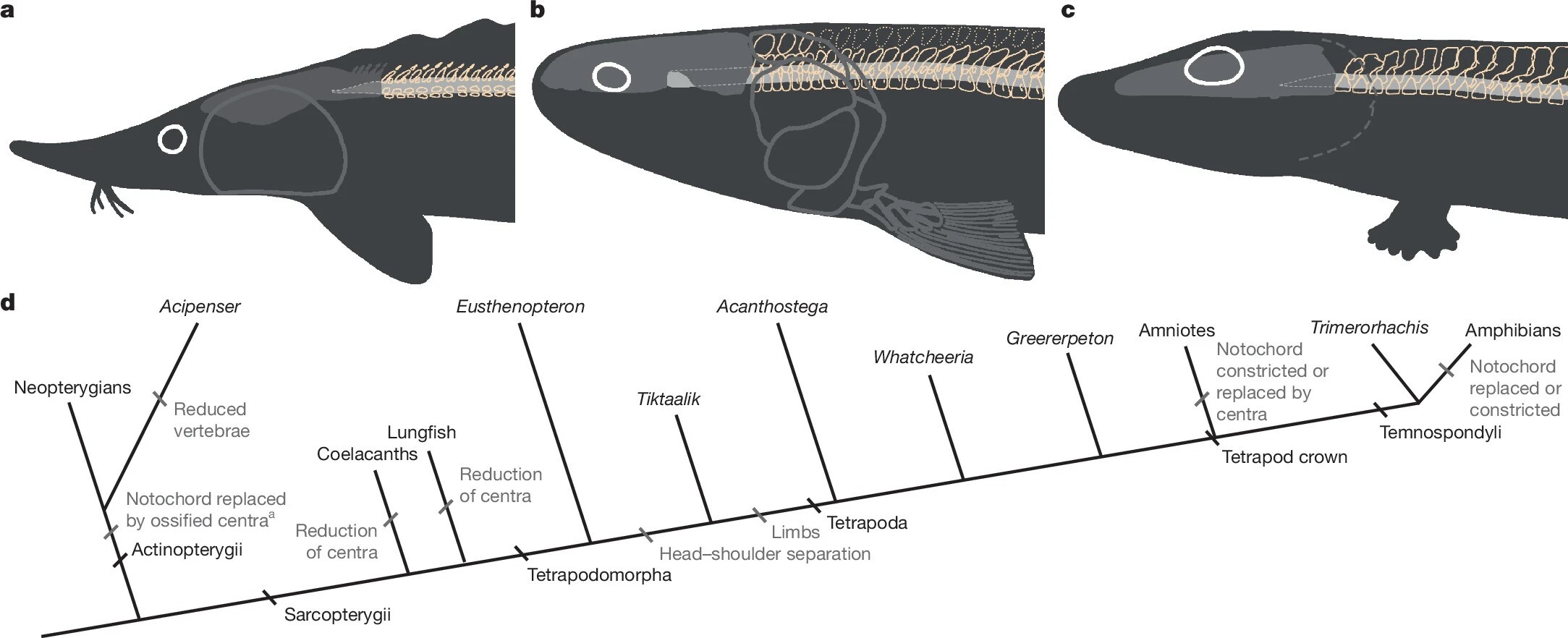
Fig. 1: Evolution of the axial column during the origin of tetrapods.
Modelling reveals that despite skull‑shoulder separation, most stem tetrapods had surprisingly rigid necks. Most taxa could bend their heads less than 6° side‑to‑side and less than 3° upward, with virtually no capacity for head rotation. Whatcheeria stands out as an exception with comparatively mobile neck.
Skull‑shoulder decoupling did not coincide with increased neck flexibility. The authors propose an alternative hypothesis: the origin of the neck was likely a mechanical by‑product of forelimb‑powered terrestrial locomotion. Restructuring of the shoulder girdle to bear weight on forelimbs physically separated the skull from shoulders, while true head mobility evolved later as a secondary feature. This revises our functional understanding of the fish‑to‑land transition.
————
References
Korneisel, D.E., Donatelli, C.M., Han, L. et al. Early tetrapod neck mobility modelled using an extant analogue. Nature (2026). https://doi.org/10.1038/s41586-026-11158-3
File Download: